To help “bring net carbon emissions to zero as quickly as possible,” what questions should I ask my MassSave contacts?
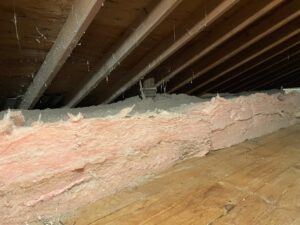
To look into your options within the MassSave program, you may contact a volunteer Acton Energy Coach with this Coaching Request Form. When speaking with MassSave, first ask your Energy Specialist and MassSave contractors for quotes to maximize your insulation. Add the amounts (and types) of insulation that would be required for a new home or recommended for a “super-insulated” home (e.g., R-65 in an attic), which will usually be more than MassSave suggests (e.g., R-50). Ask about insulating walls as well as attics, and whether there are insulation options for your home that are not offered through MassSave; these might be insulation for flat roofs or cathedral ceilings, or in finished attic spaces. Ask how you could address those limitations (e.g., with a separate insulation contractor or during re-roofing).
If your in-person, no-cost Home Assessment does not include a “blower door” test or the use of a blower door for an “advanced” air sealing process, ask for suggestions for how to contract someone who can provide this approach. Such a test can confirm that your air sealing will really reduce your home’s air leakage as much as it should.
Make sure the final work is examined by MassSave inspectors, and if needed, by local (municipal) building or electrical inspectors.
To support Acton’s net zero emissions goal, ask your Energy Specialist about rebates for additional energy efficiency measures beyond insulation and air-sealing, including opportunities to install climate-friendly heat pump systems for heating and cooling. See the Heat & Cool: Heat Pumps Action.
There are also technologies that the MassSave Home Energy Assessment and rebates do not address, including on-site solar (roof or ground mount), and electric vehicles with home charging. Make sure to ask MassSave and contractor personnel for suggestions in these areas, as well. Check out the relevant Energize Acton Actions for detailed information on these and other measures that will get Acton closer to our zero emissions goal, such as Install Solar and Drive Electric.
How important are insulation and air sealing for meeting Acton’s net zero emissions goal?
“Insulation to the Max” is a very effective step in cutting carbon emissions at home, as shown in the following table. These data are estimates by MassEnergize and Energize Acton of the number of tons of CO2 (MTCO2e) the average Actonian could stop emitting each year from these six emissions-reducing Actions.
The Top 6 Actions for Cutting Household Carbon Emissions
|
Action
|
Average Tons /Action/year
|
|
1. Switch to Green Heating & Cooling (Air Source Heat Pump)
|
3.2
|
|
2. Drive Electric (1 car)
|
2.6
|
|
Also Opt up to APC GREEN for charging use by 1 EV
|
1.5
|
|
3. Install On-site Solar
|
(2.5)
|
|
4. Insulate & Weatherize to the Max
|
1.5
|
|
5. Opt Up to APC GREEN (at average household usage)
|
1.5
|
|
Also Opt up to APC GREEN for heat pump use
|
2.0
|
|
6. Eat More Plant-Based Meals
|
0.6
|
Sources: MassEnergize Carbon Calculator Methodology, Energize Acton conversions to metric tons based on 2,204.62 pounds/metric ton.
Although “max” insulation can yield estimated emissions savings of 1.5 tons/year, even bigger reductions can be realized with heat pumps, EVs, and on-site solar. Reductions will vary from one household to the next, but if a household does all six things in this table, the carbon savings would be approximately 13 tons of carbon annually. This is roughly 74% of the average 17.5 tons of emissions per household (as counted in the 2019 Acton Greenhouse Gas Inventory) from home energy use and passenger cars in Acton. (Note: on-site solar was omitted from the 13-ton total because most of solar’s potential emissions reduction is achieved in this scenario by APC GREEN.)
Here are additional measures Energize Acton recommends beyond basic insulation and air sealing:
- Convert to an electric heat pump for heating and cooling (see Heat & Cool: Heat Pumps)
- Convert to an electric heat pump water heater
- Switch to (Electric) Induction Cooking
- Replace upper-level recessed light fixtures with insulated LED ones
- Install a draft stopper for your chimney
- Install storm windows or air seal your windows with caulk; you can consider completely replacing your windows, although the energy savings may not justify the expense of new windows
- If you need to improve air quality and preheat fresh air entering your home, especially after thorough air sealing, consider heat recovery ventilation.
Many of these improvements are better done in conjunction with others. It may be a good idea to speak with multiple contractors if you are interested in one or more of the above.
What is the basis for the estimate of 1.5 tons/year emissions reduction?
This estimate of emissions reduction is an approximation of typical/average results, used to convey relative magnitudes of various Actions, not predictions of actual results of a household’s insulation and weatherization. According to MassEnergize Carbon Calculator Methodology, 3.281 pounds of emissions are saved per year through various weatherization measures applied in the average Massachusetts single-family, income-eligible homes (taking into account various fuel types). This is calculated with estimates from the Technical Reference Manual used for the evaluation of MassSave programs and from a recent evaluation study.
The chart at this link shows some of the key savings estimates:
https://www.actonclimatecoalition.org/wp-content/uploads/2021/05/2021-04-28_MassSave_wx_savings-eval.jpg.)

Homeowners who maximize the insulation they install through Mass Save and/or other contractors may save more than the above estimates, which are for the traditional Mass Save residential program.
Nerdly metrics: how does the electricity emission factor affect the emissions reduction estimates?
MassEnergize uses an electricity emission factor of 580 Lb/MWh from MassDEP. Energize Acton converted to metric tons using 2204.62 pounds/metric ton. Notes on electricity emissions factor: The DEP factor of 580 Lb/MWh is for Massachusetts as of 2017. Since that time, Energize Acton estimates that the emission factor should have dropped by about 11% through 2021, to 517. This is based on trends of ISO-NE’s average emission factor for 2018 and 2019, and then adjusted for remaining years based on the increase in the RPS Standard (2% per year). The APC Standard electricity should be about 12% lower than 517, reaching about 454 Lb/MWh, based on its additional 10& renewable content above RPS. Based on these trends, the emission reduction estimates for all of the Energize Acton Actions linked to electricity use could be improved further, to reflect the change in emission factor from 580 to 454 (from 3.2 to 2.5). However, Energize Acton is not making this change for two reasons: (1) the ISO-NE factors for 2017 — 682 Lb/MWh average and 654 marginal — are higher than the 580 MassDEP factor and better represent the regional wholesale market from which Acton Power Choice buys electricity; and (2) we want to use consistent impact estimates to allow future comparisons with other MassEnergize towns.
UPDATE: As of 2023, you may also contact a volunteer Acton Energy Coach with this Coaching Request Form. You may also email HomeEnergy@actonclimatecoalition for more information on insulation and other home energy actions.